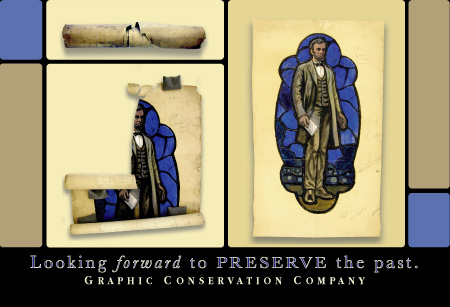
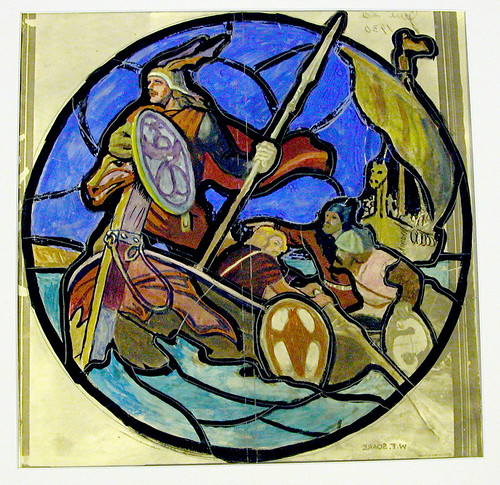
We're celebrating the 200th anniversary of Lincoln's birth with new postcards featuring the man himself. These before and after images show drawings of Lincoln by the Louis Tiffany studios used for planning the stained glass windows for the Levere Memorial Temple on the Northwestern University Campus. Click here for more images from the collection of 68 drawings as well as treatment information on preserving these beautiful drawings for future generations.
Thursday, May 14, 2009
Monday, April 13, 2009
Saving Tiffany: The Challenge of Restoring A Collection of Tiffany Studio Sketches
In April of 2004, a box of tightly rolled drawings, covered with layers of dust and dirt were delivered to our lab. The bottom of the filthy box was teeming with numerous fragments from who knows how many rolls. The drawings were so brittle, they couldn't be unrolled without causing severe damage. They were so messy, severely damaged and so incredibly delicate, we couldn't help wondering "can these things even be saved"?
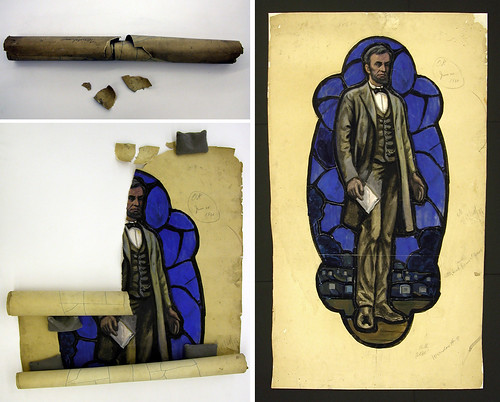
The original box (on left) of rolled drawings
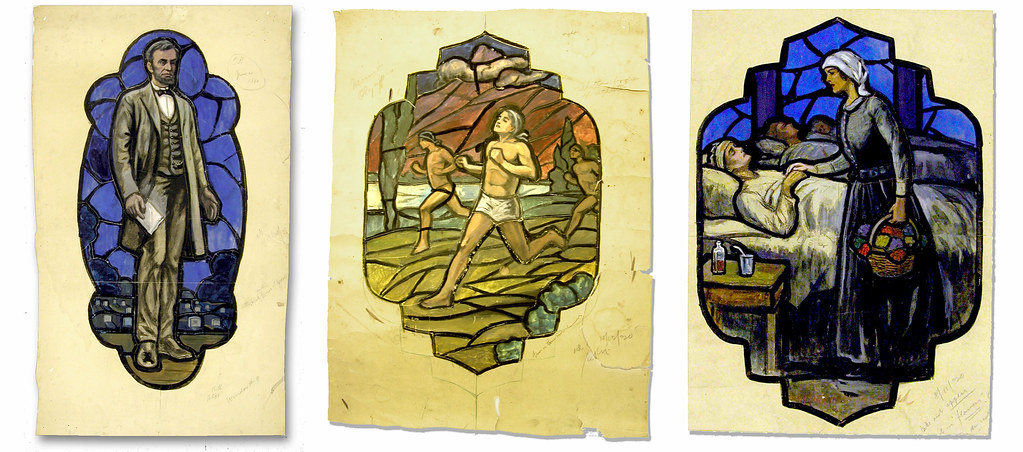
The answer had to be yes, because this beat up cardboard box contained original hand drawn designs for a one of the last series of stained glass windows produced by the Louis Tiffany Studios, before they closed their doors in 1932. These windows are the focal point of the Peace Chapel in the Levere Memorial Temple, which stands as the headquarters of the Sigma Alpha Epsilon Foundation, the largest collegiate fraternity. This grimy box of drawings complete with the original Tiffany label still attached was finally dug out of the Sigma archives where it had been stored since the Temple's construction in 1930. It was clear, these items were in desperate need of repair.
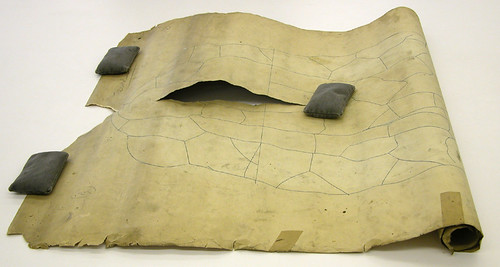
Back of one drawing unrolled as much as possible and weighted down. Tears and old tape are visible above.
Because we could not attempt unrolling them without causing damage, we were unable to perform our customary examination or treatment proposal. Our initial reports had to be made based solely on what could be examined from the exterior of the rolls, which itself was far from promising. In addition to the extensive surface dirt and brittleness, the drawings contained large tears running the width of the rolls, horizontally as well as vertically. Some old repairs had been made with a variety of poor quality tapes only adding to the overall damage and fragile state of the cartoons. We couldn't even begin to guess which drawings the hundreds of fragments matched up with. It was apparent the items would need an initial first stage of treatment before they could even be assessed.
First, we needed to gently humidify the paper in order to carefully unroll and lightly flatten the drawings to determine further treatment options. The drawings were still so dirty, they needed to have the surface dirt reduced in a series of dry cleaning treatments before they could be digitally photographed for an inventory. There were so many paper fragments, we were still unable to come up with an exact number of cartoons at the end of stage one.
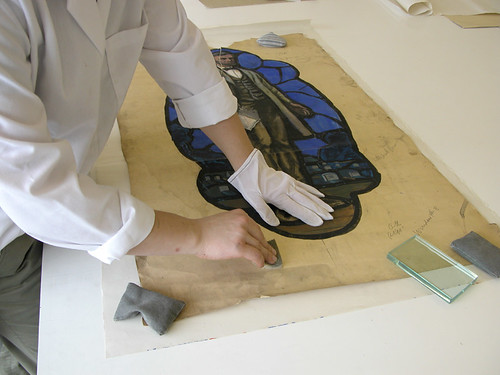
A conservator surface cleaning with a dry cleaning sponge.
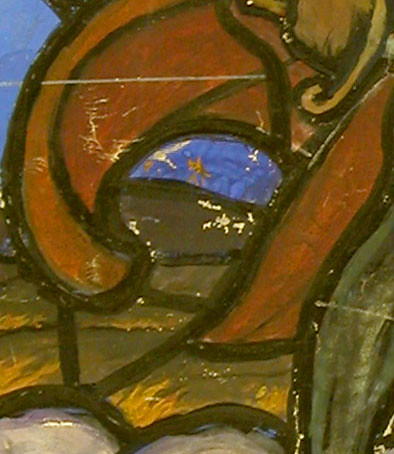
It was necessary for us to examine and test the brittle cartoons to determine the second stage of treatment. Wet treatments would strengthen the paper, but presented too much risk to the delicate painted colors which tested sensitive and soluble to water. To complicate matters, areas of this delicate paint were also beginning to crack and flake which was further aggravated by even light handling.
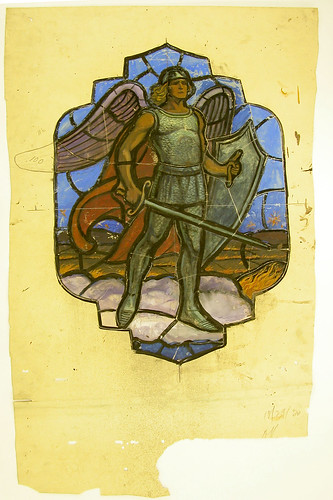
This detail of an angel drawing (full image before treatment on right) demonstrates the flaking media.
The original artists had also applied many layers of paper collage elements to the paper using very liberal amounts of what appeared to be animal hide glue. The glued collage elements were creating a pull on the paper, causing further stress and leading to tears and losses in the brittle wood pulp paper, a poor quality material to begin with which was used mainly for sketching. Originally, these drawings were only made as reference materials, with no intention of permanence.
Even the light handling of these delicate items for examination created further damage. From every direction we were faced with serious obstacles. We knew the treatment was necessary as well as nightmarish. Did we stop when presented with a challenge of this magnitude. NO!!! The gauntlet had been laid. We were itching to move forward just needing the go ahead from the client.
Drawings awaiting funding to complete stage 2 of treatment.
The project was in need of donations from members of Sigma Alpha Epsilon to move forward. To help energize fund raising efforts, we chose a single cartoon to put through the full treatments we had proposed for the group and document the process in detail. The cartoon selected for this treatment was the very iconic image of everyone's favorite president, Abraham Lincoln!
The two images on the left show the before images with the after image on the right.
The Abraham Lincoln drawing was further cleaned and all old repairs were removed. Tears were painstakingly repaired using Japanese tissue and starch paste adhesive. Losses in the paper were filled with a heavy weight Japanese tissue. The cartoon was again placed into a humidity chamber to relax before being gently flattened between wool felts. Design losses were inpainted by hand to match the surrounding areas. The Lincoln cartoon was matted with 100% buffered rag board and placed behind UV filtering plexi glass in preparation for being placed into a frame for display.
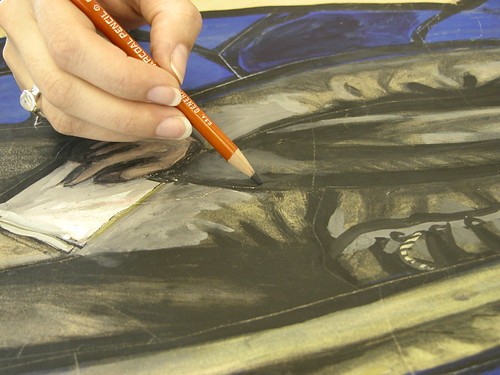
Media losses on the Lincoln drawing being filled with removable media.
The results were absolutely stunning. Over the next two years, the foundation was able to raise tens of thousands of dollars thanks in part to the persuasive efforts of Honest Abe on generous benefactors. The treatment for the remaining 68 cartoons was completed by the end of 2006.
After treatment of drawing of Vikings.
Back in 2004, when the many rolls of severely damaged paper arrived at our facility, it was unclear if the items could even be saved. It was miraculous and rewarding to see the project go from conception to completion These cartoons are now preserved to aid future generations in gaining a key insight into the execution of this wonderful and important collection of Tiffany stained glass windows.
Tuesday, March 3, 2009
Fund the Trust, Frank Lloyd Wright Needs Your Help
Everyone knows conservation is awesome! That's why we were happy to host a tour for the Frank Lloyd Wright Preservation Trust this past week. The tour, designed to energize volunteers and members, was given in an effort to kick-off the fund raising efforts for a final group of Frank Lloyd Wright prints. We love our jobs here at Graphic Conservation, so you don't have to ask us twice to spend an hour or two talking about it! We showed our guests around to the different areas of the lab, and enjoyed totally nerding out on all kinds of conservation terms and processes. Of course, no tour is complete without a brief demo and a few before and after treatment examples.
The fund raising efforts are going toward a final group of 17 plates for the FLW Preservation Trust's edition of the Wasmuth Portfolio, which is one of the few complete sets in existence. The publication of Frank Lloyd Wright's 1910 Wasmuth Portfolio, consisting of 100 plates featuring his plans and perspective of buildings from 1893-1909, gave the world it's first view of his dynamic and world changing style. Because of the beauty and desirability of these plates, many portfolios have been dismantled and sold for parts. Both the rarity and the historical importance of this complete portfolio make it one of the prizes of the Frank Lloyd Wright Preservation Trust's collection.
As many other foundations dependent on donations to fund conservation have done when dealing with huge projects, the Trust opted to break the plates up into groups allowing them to be treated incrementally over a number of years. We've been working on the conservation and preservation of these plates for over a decade and you can imagine how excited we are to have this project almost completed. The Frank Lloyd Wright Preservation Trust hope to fund this project completely by private donations. If you would like to take part in this project, please feel free to contribute today!
Interested in more information on the Wasmuth Portfolio? Check out the University of Utah's full online catalog of each plate. These look like they could use a little help from us!
Thursday, February 26, 2009
Jump Start Your Spring Cleaning!
The winter of our discontent is almost over and spring will be here soon!
To celebrate the better days ahead, Graphic Conservation wants to help kick start your spring cleaning. For a limited time only, we're offering a free storage mat an/or encapsulation package with any approved conservation treatment.
So stop feeling guilty about the rolled up artwork under the bed, and bring it in to get freshened up and placed in a safe archival storage mat for free.
Contact us for more information!
Friday, January 23, 2009
Treatment is complete, now what?
So much of the artwork we treat here has been damaged by improper materials used for framing or from poor storage choices. Because works of art on paper are extremely vulnerable to damage, the methods and materials we choose are selected carefully to promote the safety and longevity of the piece.
After conservation treatments, to ensure that the time and cost were well spent, we need to consider what the future of the art is. Will it be hung on a wall? Stored in a safe place? Or is this something meant to be viewed and handled a lot? We have various finishing options for your art that are in stride with the guidelines of the American Institute for Conservation.
Let's say that after conservation treatments that antique document of yours is probably going to be looked at quite a bit, but you're not sure if you want to have it framed, let alone figuring out just where to put it.After conservation treatments, to ensure that the time and cost were well spent, we need to consider what the future of the art is. Will it be hung on a wall? Stored in a safe place? Or is this something meant to be viewed and handled a lot? We have various finishing options for your art that are in stride with the guidelines of the American Institute for Conservation.
For something like this, we would recommend a storage mat. This will safely house the document, as well as allow for it to be handled without touching the actual object. A storage mat is a great option for long term storage if you choose not to frame the artwork. Although, if you do choose to frame it, the protective cover can be flipped to the back, providing an extra layer of archival backing.
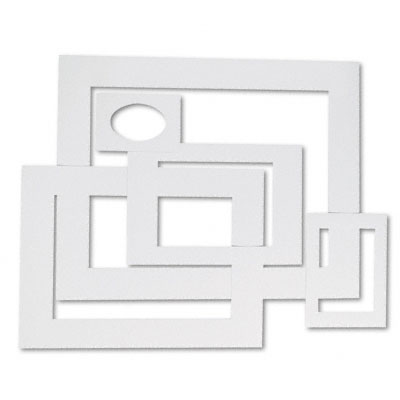
To place artwork into a storage mat, made of 100% rag board, we would use a hinging method that is appropriate for the piece; utilizing archival materials such as Japanese tissue and wheat starch paste. In some cases, mylar corners will work best for the art. The facing mat is an important component to the storage mat, not only for being the "window" surrounding the the front of the art, but because it protects the artwork from having direct contact with the glazing material [such as plexi-glas or glass].
Another option is to have the artwork encapsulated. Encapsulation is a process in which the artwork is placed between 2 sheets of mylar, an inert plastic product, and ultrasonically welded at its edges to prevent the contact with dirt, dust, etc. Unlike lamination which is virtually impossible to reverse, encapsulated artwork is actually floating between the 2 sheets of mylar, and at any time can be reversed. The mylar can be cut at one of its edges and the artwork simply slipped out.
Encapsulation is a sound option for something like a newspaper which is delicate to begin with, but if the newspaper has fragments or is an object that will be handled a lot, the encapsulation will allow for such. This process works well for items of a double sided nature where information on both the front and back needs to be seen.
Our museum quality matting and encapsulation options have lots of variables to meet your finishing requirements. However basic or seemingly complicated those needs are, Graphic Conservation will make the best choice for the artwork.
Labels:
archival mat,
encapsulation,
storage mat
Wednesday, December 10, 2008
Original Order Forms Found Hidden Under Hood, Important in Classic Car Appraisal
People always ask about the strangest items we've treated. The story of two horribly damaged classic car order forms always come to mind because of the odd nature of their condition and the miraculous transformation achieved during their treatment.


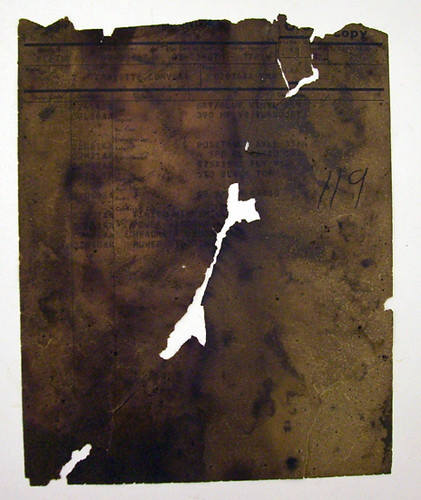
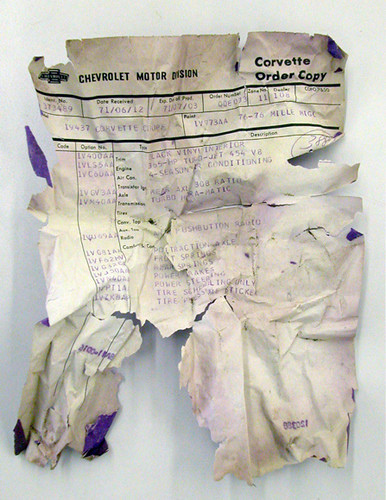
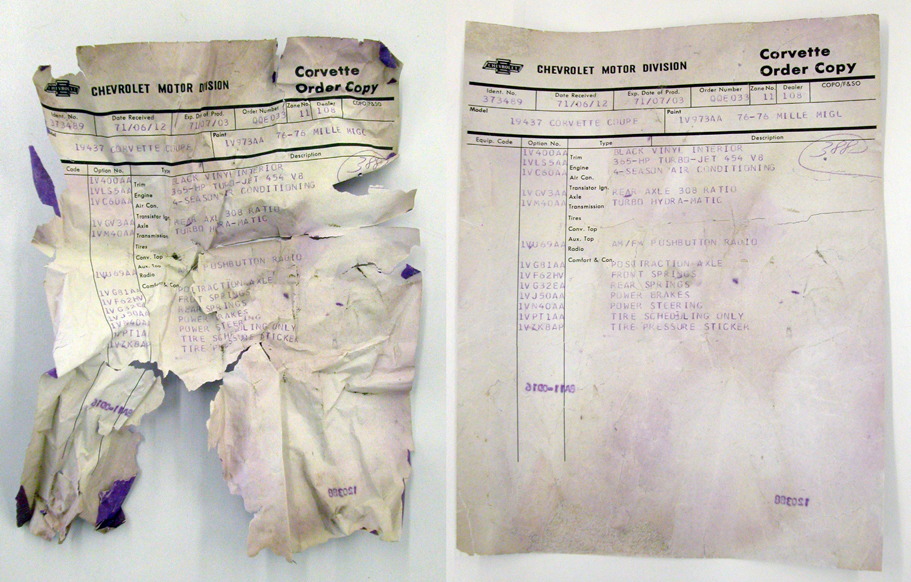
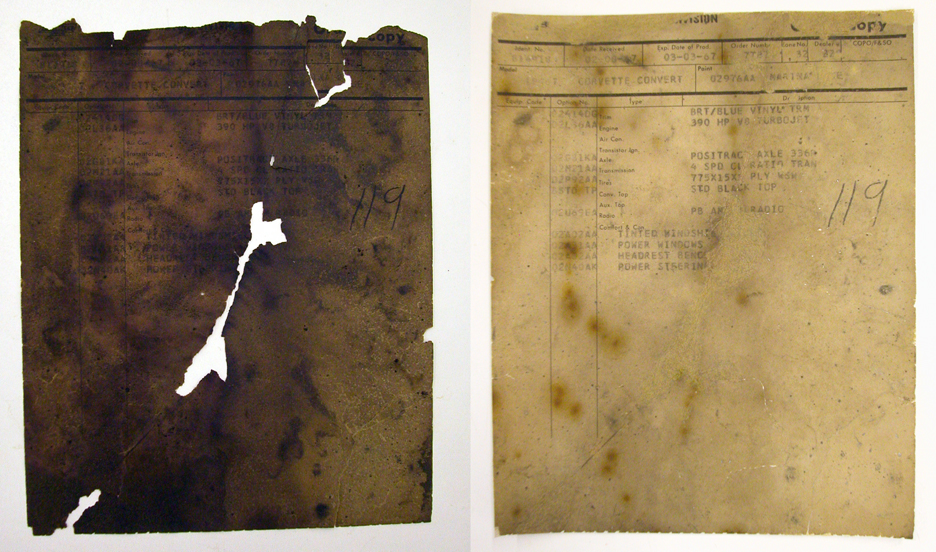
Original order forms for 1967 Corvette convertible on left and 1971 Corvette coup on right.
A private client who collects vintage Corvettes was interested in conserving two original order forms for cars he had recently purchased. The paperwork for each car had been badly handled and poorly stored. In fact, the document on the left had been found hidden within the car mechanics, where it suffered greatly from exposure to exhaust and oil residue. Both documents were so severely dessicated and brittle, they couldn't be handled without causing more fragments from breaking off.
We started by tackling the '67 convertible paperwork to attempt the reduction of the heavy dirt layer and extensive staining due to residual grease and oil present overall.
Our aqueous tests were initially unsuccessful due to the amount of grease and oil present in the document. The picture above shows how the grease and oil are preventing the absorption of water into the paper which is necessary to stabilize the fibers.

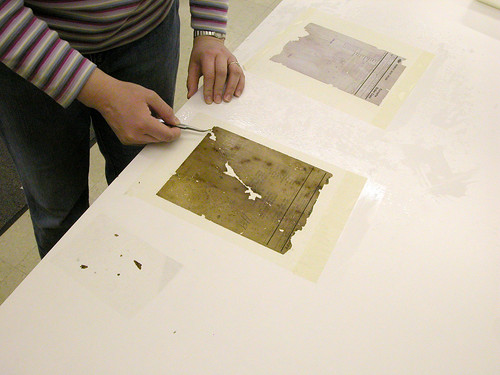
Through a series of organic solvent tests, we were able to come up with a solution which would act as a type of degreaser. With the delicate application of the solution to the item with a pipette on a suction table, we were able to greatly reduce the dark staining from the oil and exhaust residue.

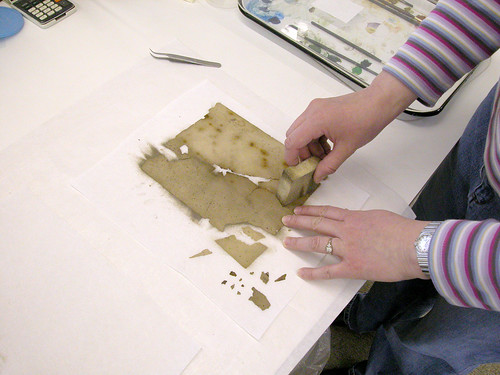
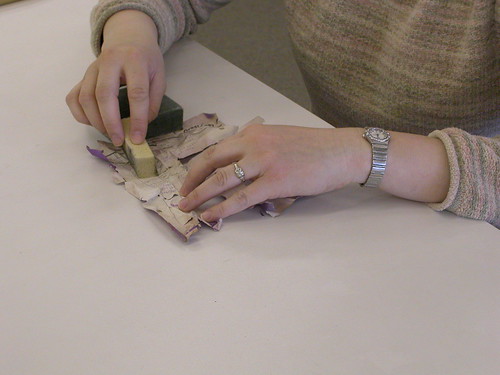
After the solvent treatments, we were then able to further reduce the exhaust residue and other surface dirt through various dry cleaning methods including the use of a dry cleaning sponge as demonstrated above and below.

At this point, we could begin treating the documents in tandem. The convertible document needed to be dry cleaned delicately because the brittle paper was prone to further tearing and fragmentation (above).

The large amount of overall damage to the documents required an overall lining to a Japanese tissue using wheat starch paste to repair tears, reinforce creases and stabilize the weak fibers of the paper.

The small fragments were then hand placed with tweezers, and paper losses were filled using a matching liquid paper pulp to give a seamless appearance to the documents. The documents were then placed in a press to flatten between wool felts. Once flattened, the paper losses filled with liquid paper pulp were toned using colored pencils and watercolor to match the surrounding paper. The documents were now fully stabilized and complete.

Before and after images of the original order form of a 1971 Corvette convertible

Before and after images of the original order form of a 1967 Corvette coup.
The results speak for themselves. The documents are now much stronger and can be handled safely ensuring the access to their important information as proof of provenance for these valuable classic cars.
Check out other before and after treatment images from our many other projects!
Original order forms for 1967 Corvette convertible on left and 1971 Corvette coup on right.
A private client who collects vintage Corvettes was interested in conserving two original order forms for cars he had recently purchased. The paperwork for each car had been badly handled and poorly stored. In fact, the document on the left had been found hidden within the car mechanics, where it suffered greatly from exposure to exhaust and oil residue. Both documents were so severely dessicated and brittle, they couldn't be handled without causing more fragments from breaking off.
"Original paperwork is extremely important, as it can establish how the car was ordered new, where the car was originally sold, and how the car was originally equipped. These are absolutely critical components to determining the provenance and value of a vintage Corvette." -Steve Davis, President of Barrett-Jackson Auctions, from VetteWeb.comDue to the importance of these documents to their respective cars, our client was very eager for the stabilization of the documents which would allow for the safe viewing and handling of the information which was currently obscured by all the damage.
We started by tackling the '67 convertible paperwork to attempt the reduction of the heavy dirt layer and extensive staining due to residual grease and oil present overall.
Through a series of organic solvent tests, we were able to come up with a solution which would act as a type of degreaser. With the delicate application of the solution to the item with a pipette on a suction table, we were able to greatly reduce the dark staining from the oil and exhaust residue.
After the solvent treatments, we were then able to further reduce the exhaust residue and other surface dirt through various dry cleaning methods including the use of a dry cleaning sponge as demonstrated above and below.
At this point, we could begin treating the documents in tandem. The convertible document needed to be dry cleaned delicately because the brittle paper was prone to further tearing and fragmentation (above).
The large amount of overall damage to the documents required an overall lining to a Japanese tissue using wheat starch paste to repair tears, reinforce creases and stabilize the weak fibers of the paper.
The small fragments were then hand placed with tweezers, and paper losses were filled using a matching liquid paper pulp to give a seamless appearance to the documents. The documents were then placed in a press to flatten between wool felts. Once flattened, the paper losses filled with liquid paper pulp were toned using colored pencils and watercolor to match the surrounding paper. The documents were now fully stabilized and complete.
Before and after images of the original order form of a 1971 Corvette convertible
Before and after images of the original order form of a 1967 Corvette coup.
The results speak for themselves. The documents are now much stronger and can be handled safely ensuring the access to their important information as proof of provenance for these valuable classic cars.
Check out other before and after treatment images from our many other projects!
Labels:
classic car,
corvette,
paper conservation,
preservation
Thursday, November 13, 2008
Change You Don't Want: Keeping Your Obama Newspaper From Disintegrating
Obama Newspaper Front Pages Mosaic made of 477 different Newspapers
from around the world. Uploaded by Flickr User Lumis. Click here to zoom
in and see each page.
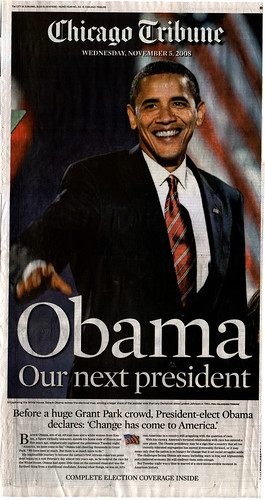
History was made last week in Chicago as our senator was announced the first African American President of the United States. The next day, people queued up in front of newspaper vendors worldwide hoping to get their own piece of history.
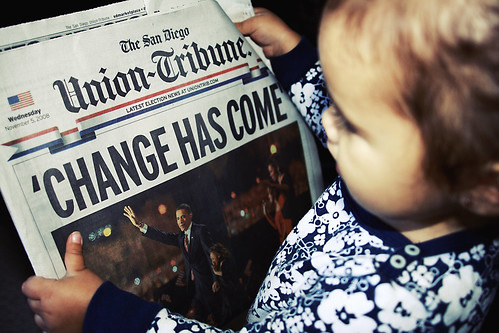
Change posted by Flickr user Michelle's House
Here in Chicago, lines outside of the Tribune Building on Michigan Ave went around the block as thousands of papers were distributed to the clamoring public. Over the past week, we've received many inquiries as to the proper method for preserving these newspapers from deteriorating over time.
Newspaper, due to the wood pulp content of the paper, naturally becomes acidic over time which can cause the fibers to become brittle as well as a yellowish staining to the paper overall. While we can't stop this from happening, we can slow down the process. Here are a few tips we hope will help.
- Store your newspaper flat. This will protect the fibers at the central horizontal crease from weakening which can result in tears and losses.
- Protect your newspaper in acid free archival materials to protect it from absorbing additional acids from poor quality paper and cardboard.
- Provide a rigid support to keep your newspaper from becoming bent or torn during storage and handling.
Newspaper Folder available from Archival Products

Available from Archival Products for only $12.37!
This is the best quality and most affordable folder we found which matches all our necessary criteria at a. Priced at $12.37, the folder is made of boards thick enough to provide a rigid environment and are of a high quality acid free buffered with an alkaline reserve pH of 8.5 which will provide a safe long term acid free environment for your newspaper storage. The folder has a clear sleeve made of acid free Melinex sewn into the folder which gives further stabilization to the newspaper and allows for the safe viewing of both sides of the newspaper without handling.
Acid Free Tissue Interleaving available from
Gaylord Archival Products

tissue pack of 25 sheets available from Gaylord Archival Products for $29.05
We also recommend interleaving the pages of the newspaper with acid free tissue or paper. A 25 sheet pack of buffered archival tissue is available from Gaylord Archival Products for $29.05. The 30" x 40" sheets can be cut down to custom fit the pages of your newspaper.
If you don't wish to interleave the whole paper, it is advisable to at least interleave the front page, which is generally considered the most important. You can go to an art supply store and ask for a sheet of acid free paper which is large enough for your newspaper. Sheets of acid free paper are also available from Papersource.com.
The Big Book Oversize Scrapbook available from
Light Impressions

Scrapbook available from Light Impressions for $52.95
If you wish to go the full ten yards, oversize Scrapbooks are available from Light Impressions which will allow you to fully display each page of your newspaper, along with other affiliated memorabilia. Acid free clear polyester page covers are available to protect the newspaper once hinged to the page and you can even have your scrap book personalized with printed text for only a couple more dollars!
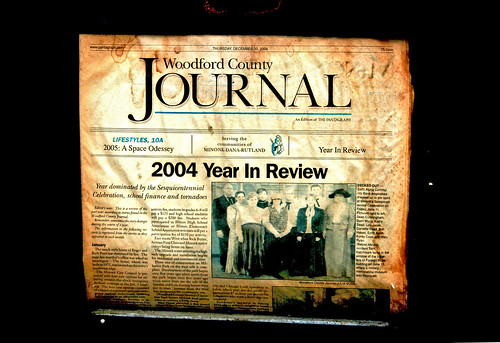
These options, we hope will help you look toward the future to preserve the past. The goal is to keep you paper looking like this:
Rare Dewey Newspaper posted by Rag Linen and Rare Newspapers
and not like this:
Woodford County Journal, 2004 posted by Flickr user Mcbeth.
Subscribe to:
Posts (Atom)