Showing posts with label paper conservation. Show all posts

Wednesday, December 10, 2008

Original Order Forms Found Hidden Under Hood, Important in Classic Car Appraisal

People always ask about the strangest items we've treated. The story of two horribly damaged classic car order forms always come to mind because of the odd nature of their condition and the miraculous transformation achieved during their treatment.


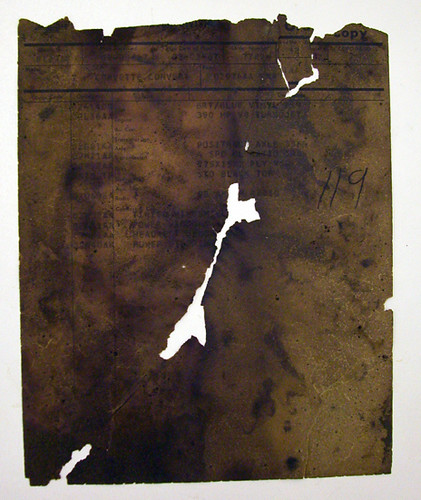
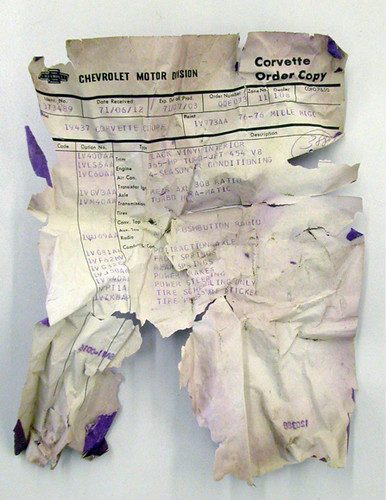
Original order forms for 1967 Corvette convertible on left and 1971 Corvette coup on right.

A private client who collects vintage Corvettes was interested in conserving two original order forms for cars he had recently purchased. The paperwork for each car had been badly handled and poorly stored. In fact, the document on the left had been found hidden within the car mechanics, where it suffered greatly from exposure to exhaust and oil residue. Both documents were so severely dessicated and brittle, they couldn't be handled without causing more fragments from breaking off.
"Original paperwork is extremely important, as it can establish how the car was ordered new, where the car was originally sold, and how the car was originally equipped. These are absolutely critical components to determining the provenance and value of a vintage Corvette." -Steve Davis, President of Barrett-Jackson Auctions, from VetteWeb.com
Due to the importance of these documents to their respective cars, our client was very eager for the stabilization of the documents which would allow for the safe viewing and handling of the information which was currently obscured by all the damage.

We started by tackling the '67 convertible paperwork to attempt the reduction of the heavy dirt layer and extensive staining due to residual grease and oil present overall.

Our aqueous tests were initially unsuccessful due to the amount of grease and oil present in the document. The picture above shows how the grease and oil are preventing the absorption of water into the paper which is necessary to stabilize the fibers.


Through a series of organic solvent tests, we were able to come up with a solution which would act as a type of degreaser. With the delicate application of the solution to the item with a pipette on a suction table, we were able to greatly reduce the dark staining from the oil and exhaust residue.
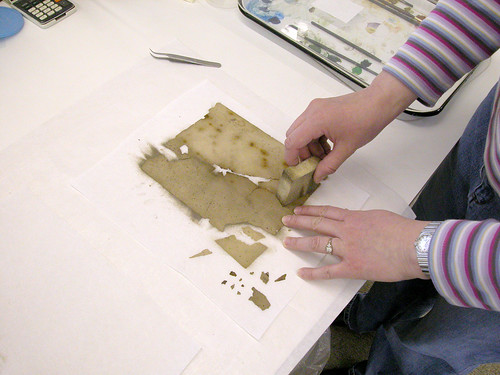


After the solvent treatments, we were then able to further reduce the exhaust residue and other surface dirt through various dry cleaning methods including the use of a dry cleaning sponge as demonstrated above and below.
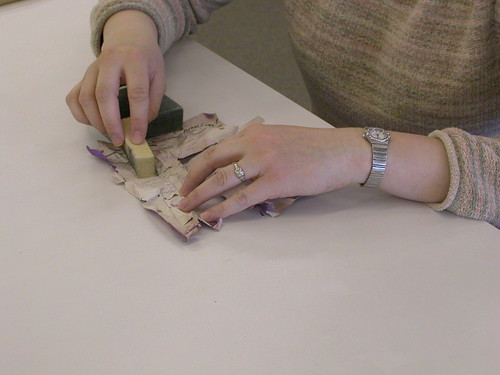


At this point, we could begin treating the documents in tandem. The convertible document needed to be dry cleaned delicately because the brittle paper was prone to further tearing and fragmentation (above).


The large amount of overall damage to the documents required an overall lining to a Japanese tissue using wheat starch paste to repair tears, reinforce creases and stabilize the weak fibers of the paper.
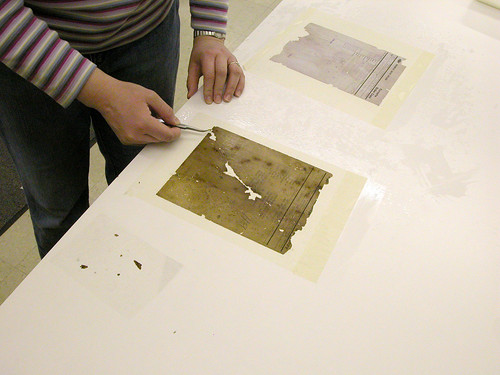


The small fragments were then hand placed with tweezers, and paper losses were filled using a matching liquid paper pulp to give a seamless appearance to the documents. The documents were then placed in a press to flatten between wool felts. Once flattened, the paper losses filled with liquid paper pulp were toned using colored pencils and watercolor to match the surrounding paper. The documents were now fully stabilized and complete.
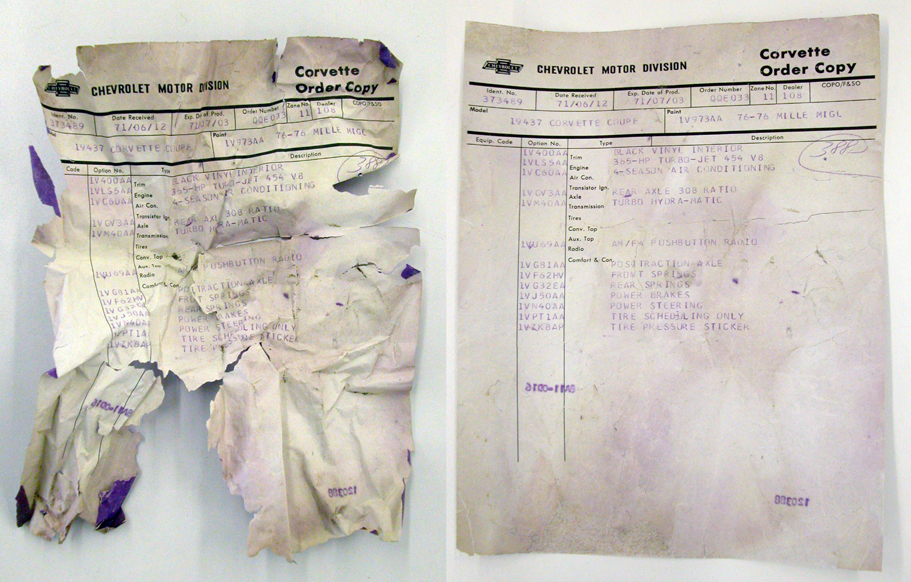

Before and after images of the original order form of a 1971 Corvette convertible
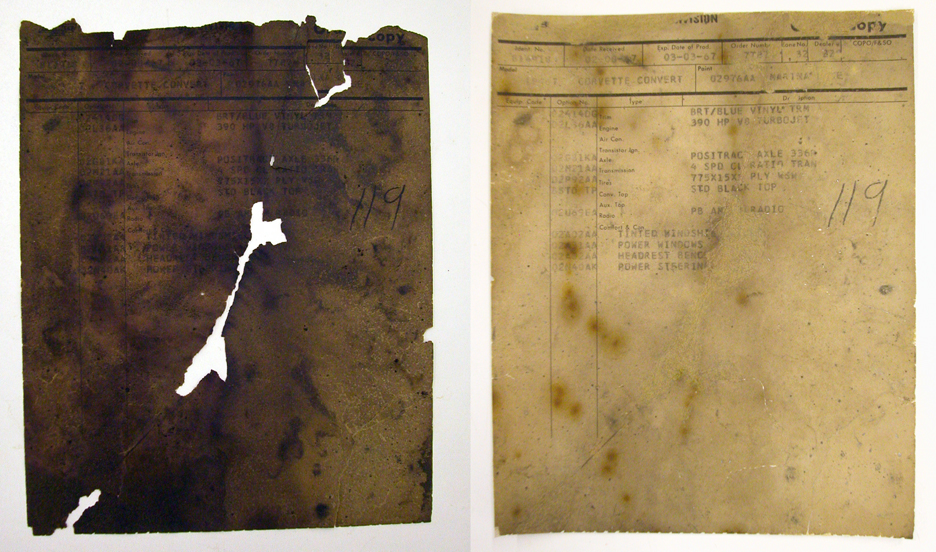

Before and after images of the original order form of a 1967 Corvette coup.

The results speak for themselves. The documents are now much stronger and can be handled safely ensuring the access to their important information as proof of provenance for these valuable classic cars.

Check out other before and after treatment images from our many other projects!

Wednesday, September 24, 2008

The Enemies of Paper

Our frequently asked questions are often in regards to the proper methods for storing artwork on paper. It is not uncommon for us to encounter art which is darkly stained and brittle from prolonged exposure to direct sunlight. Art may appear very wavy and wrinkled or may even be darkly stained and covered with mold due to unknown water damage from being stacked away in the basement. The best ways to avoid damage is to safely store your items in the proper means using quality archival materials which will add and not subtract years to your artworks life expectancy.

In order to know what is good for your artwork, we first need to investigate what is BAD for your artwork.


What are the Enemies of Paper?

One of the most important things to keep in mind when dealing with your documents or works of art on paper, is that paper itself is an intrinsically delicate material and very susceptible to certain kinds of damage. It is the natural course for all things to deteriorate and break down over time. The most common ways in which paper can be broken down are:
  • the absorption of acids
  • exposure to harmful UV light rays
  • improper exposure to areas of fluctuating humidity
Acid is BAD
Through the natural process of degradation, paper absorbs acid from its environment which over time can contribute to weakening the fibers. The most noticeable way in which this damage becomes visible to us is by a yellowish staining as well as a brittle feel in the fibers which can cause tears and losses in the paper.


Above shows the back of a print which was framed with a wooden backing board for many years. Over time, acids migrated into the paper from the wooden backing board, severely damaging the paper fibers and causing dark disfiguring stains. Notice the stain patterns mimic the knots in the wood.

When paper has contact with materials high in acid content like wood, it can absorb acids through the process of acid migration. It can also absorb acids from chemically unstable materials like plastics as well as from pollutants in the air. As this is a natural process, we cannot totally stop it, but we can retard its progress by keeping harmful materials away from the artwork with the use of safe archival storage and archival framing materials.

UV Light Rays are Bad
As we all know after a long day out in the sun, UV light rays can be very harmful to our skin, as we ache from the pinkish burns all over our bodies. Paper fibers can be affected by harmful UV rays in a similar manner, and after long hours of direct exposure, fibers can begin to break down, showing a "burn" which can appear as a yellowish stain. Besides UV in natural sun light, UV light rays are also emitted by fluorescent and metal halogen lamps. It is best to limit the direct exposure to all of these light sources to protect your artwork from UV damage.


Although more energy efficient, fluorescent light bulbs, like the one on the left, emit more UV rays then the incandescent light bulb on right.

General exposure to light can also cause fading to the media of your artwork over time. Different media such as watercolors, lithographic prints and documents with ink pen notation among others are very susceptible to fading from light exposure.

Fluctuations in Humidity are Bad

Paper naturally absorbs and emits moisture from the surrounding air causing fibers to expand and contract. With high fluctuations in humidity, the paper's moisture content can fluctuate at a high rate causing such damage as cockling and buckling, and over time can undermine the structural integrity of the fibers, leading to damage.

Besides fluctuations in humidity, paper exposed to environments of high humidity for extended periods of time can create a prime environment for mold growth. Once mold spores have permeated into the web of the paper fibers, it is incredibly difficult to remove. Mold can also cause disfiguring staining which can be difficult and sometimes impossible to completely reduce during treatment.


Moldy Book Page Image originally uploaded by Flickr user Eric Carl

To protect your artwork, avoid storing or hanging artwork in areas of high humidity and moisture like in basements and bathrooms. You want to avoid storage in attics due to fluctuations in temperature and humidity. Try to avoid hanging artwork on exterior walls and above fireplaces.

Now we know what the main enemies of paper are, how should art be stored?

Proper Art Storage Methods
A cool dry dark area is best, to protect the item from exposure to harmful light rays, and from fluctuations of temperature and humidity. A cool dry environment of a relative humidity (RH) around 50 percent is preferable. (Please note: 50% RH humidity is a general recommendation. Certain objects may require different humidity and storage conditions.) To further control the humidity, de-humidifiers may be necessary in warmer months to maintain a stable and constant RH. To properly store your artwork, wrap with archival tissues or place in archival folders made of stable pH neutral polyester folders to protect from dust and during handling.


Selection of Archival boxes available from Gaylord Archival Products

Artwork and other documents on paper should always be stored flat in a rigid environment. Rolled storage should be avoided all together. Items with delicate surfaces or 3 dimensional aspects can be safely stored in archival boxes which come in many different shapes and sizes.

For more resources of archival products visit these websites:
Light Impressions
Gaylord Archival Products
Tallas
Archival Products
University Products


More resources for archival concerns can be found on our website.